As the title of my review makes clear, I really didn't want to read this book.
It showed up at my door, unsolicited, and I groaned inwardly when I looked at
the cover. I just knew this was going to be one of those books where the author
has a life-changing experience about world poverty and tries to make everyone
with a middle class American life feel all guilty about it.
Even though I
didn't want to read this book, I decided to read the cover blurb and look at the
pictures. Then I read the first couple chapters and skimmed around the rest of
the book. As I skimmed, I realized the author wasn't putting out
holier-than-thou attitude -- in fact he made fun of himself a lot. The more I
skimmed, the more interested I was, so I went back to the beginning and started
reading. I barely put it down all that weekend.
In part this is a story
about a family that suffered the loss of a child and took a break from their
regular lives to be dorm parents in a boarding school in Kenya for the children
of missionaries and then decided to stay at the school long term. In part this
is a story about Kenya, with descriptions of the land and the people, including
both the good and the bad. And in part this is a story about how small things
can add up to big changes.
The author's choice to include amusing daily
life stories, such as the boys in his dorm wanting to have the stinkiest room
and self-deprecating stories about his struggles with the language, keep this
book from becoming preachy or holier than thou. You have to laugh along with
someone who can laugh at himself. Those stories provide much-needed breaks from
the description of poverty on a scale no one in the USA can imagine and children
so hungry they have to lie down in school.
The main point of the book --
and the reason the lighter anecdotes are important to keep the reader captivated
-- is poverty and hunger. It's such a big issue that most of us end up feeling
helpless to do anything about it. The author started small -- he had a plan to
provide lunch for one or two nearby Kenyan public schools so the children would
stay in school, get an education and have a better chance for the future. Over
time his organization, Kenya Kids Can, grew to provide daily lunches for 20,000
children in 35 schools and built 20 solar-powered computer centers at
schools.
By the end of the book, I didn't feel guilty. I felt hopeful.
Little things we can do can make a big difference in Africa and around the
world. In addition to the author's organization, there are local and national
charities that are involved in We can In my home state of Minnesota there is an
organization called Feed My Starving Children that uses volunteers to pack food
that costs 22 cents per meal and is sent all around the world. World Vision is a
larger global relief organization. And there are plenty more.
We don't
all have to go to Africa (for which I am thankful as I'd be a terrible
missionary). Anyone can do small things -- give up a latte once a week (or even
just once) and donate the money. Kids could have a lemonade stand and send the
money to feed children around the world. The last couple years I have walked a
half marathon to raise money for World Vision but was not planning to do it
again this summer. But after reading this book, I decided this was one thing I
could do to help.
I really didn't want to read this book, but I'm glad I
did.
Disclosure: I received an unsolicited free copy of this book from
the publisher in hopes that I would write a review. My opinions are my own.
Tuesday, March 19, 2013
Saturday, December 8, 2012
The Purpose Driven Life -- What on Earth am I Here For?
I did the Purpose Driven Life study in a small group with my church back when it first came out and I then thought it was a great book and made me think a lot about my life. But time goes by and life goes on and a lot of the things I thought would change in my life ended up staying the same. And you see the same old book jacket on your shelf and never think to take it down again.
But some books are worth picking up again after a number of years and I think this is one of them. And this new edition will has features that will appeal to young adults who were too young the first time it came out as well as the technologically savvy.
Back when this book came out, people didn't bring their Bibles to church in the form of an iPad, iPod or iPhone and they weren't watching TV and movies on devices they could hold in their hands. But now they do and this book has features that take advantage of the advances in technology. At the beginning of each chapter, there is a QR code (the funny looking block of pixels) and when you take a photo of it with your smartphone, you get a 3 minute video inroduction to the chapter from Rick Warren plus an audio lesson for the end of the chapter and a Bible study guide. I have a "stupid phone" so I borrowed a friend's phone to try it out. For those of us a little behind the digital revolution, there is a URL you can type into your internet browser and get the same features on your computer.
In addition to the tech-y bells and whistles, there are two new chapters at the end of the book -- making this a 42 day journey instead of the old 40 days. This means if you want to do this for Lent, you need to start a little bit in advance.
The new chapters are, like the rest of the book, really good. They are on two things that keep Christians from fulfilling God's purpose for their lives -- the envy trap and the people pleaser trap. The chapter on envy felt like it was written just for me, especially when he said that envy is an insult to God because you are saying God made a mistake with your life by not giving you the things other people have that you envy. Wow. And people pleasing/fear of disapproval is another almost universal issue.
The new chapters, audio and video messages improve what was already a very good book. It's time to do this Bible study again.
But some books are worth picking up again after a number of years and I think this is one of them. And this new edition will has features that will appeal to young adults who were too young the first time it came out as well as the technologically savvy.
Back when this book came out, people didn't bring their Bibles to church in the form of an iPad, iPod or iPhone and they weren't watching TV and movies on devices they could hold in their hands. But now they do and this book has features that take advantage of the advances in technology. At the beginning of each chapter, there is a QR code (the funny looking block of pixels) and when you take a photo of it with your smartphone, you get a 3 minute video inroduction to the chapter from Rick Warren plus an audio lesson for the end of the chapter and a Bible study guide. I have a "stupid phone" so I borrowed a friend's phone to try it out. For those of us a little behind the digital revolution, there is a URL you can type into your internet browser and get the same features on your computer.
In addition to the tech-y bells and whistles, there are two new chapters at the end of the book -- making this a 42 day journey instead of the old 40 days. This means if you want to do this for Lent, you need to start a little bit in advance.
The new chapters are, like the rest of the book, really good. They are on two things that keep Christians from fulfilling God's purpose for their lives -- the envy trap and the people pleaser trap. The chapter on envy felt like it was written just for me, especially when he said that envy is an insult to God because you are saying God made a mistake with your life by not giving you the things other people have that you envy. Wow. And people pleasing/fear of disapproval is another almost universal issue.
The new chapters, audio and video messages improve what was already a very good book. It's time to do this Bible study again.
Sunday, February 6, 2011
"The Informationist" by Taylor Stevens is an intriguing debut thriller 5 stars
This book really surprised me -- in a good way. I wanted to read it because I like thrillers with female main characters -- the idea of strong resourceful women in thrillers is a pleasant change from the testosterone fests that thrillers often become. I really enjoyed this book and think both men and women would find it a good read. There is plenty of action for the guys (plus there are male main characters as well so it isn't a chick fest). And for women the vicarious thrill of a female character taking down the bad guys! But this wasn't the typical thriller I was expecting.
From the jacket blurb, I knew the protagonist of this book would be strong and resourceful. Despite the jacket blurb. I just didn't realize how dark and twisty her inner self would be. That dark and twisty side sometimes gets in the way of the story but it also creates an unusual and very intriguing character. This isn't someone trained in special forces or spy school to kill without emotion as in many thriller novels. The scars she has -- both inside and outside -- show the price she paid to acquire her skills. There is a darkness in her that she acknowledges but can't seem to escape for long.
The interesting differences in the book start with the character's name. The book jacket describes her as Vanessa Monroe but for most of the book she goes by the name Michael and seems to have spent a far amount of time masquerading as a boy or young man. Part of the darkness of Munroe's character comes out of her background as a missionary kid in Africa. She was left on her own much of the time by older parents who appear, from the judgment-filled Scriptures she often hears in her head, to have adhered to a hellfire and brimstone brand of theology. (The author bio indicates she was raised in a cult so I wouldn't expect a lot of warm fuzzies about religion from her.)
More of the source of her darkness comes later in the book when Monroe thinks back to the events that led her to leave Africa. That time also explains the source of the skills she uses in doing her work.
The book started a little bit slow for me (some of which, oddly, was from the typeface used in the advanced readers copy I got). So bear with it if you don't get hooked right way. But once I got into the book, I could hardly put it down. And after that, the pace was nearly perfect. I didn't feel the urge to skip ahead and that is rare for me as I often get bored and want to see what comes next. While I was caught up in the book, I resented the time I had to spend working and sleeping and thus away from the action.
Africa -- particularly Cameroon and Equatorial Guinea -- is almost a character of its own in the book. You should know this is not the Africa of the No. 1 Ladies Detective Agency books with happy pleasant people. It is a hard and dangerous place, especially for foreigners poking into things others want kept secret.
I think at least a glance at the geography of the area in which the bulk of the book takes place would be helpful to follow the characters' travels in Africa. I was generally familiar with the location of Cameroon but Equatorial Guinea was a mystery. It was a surprise when I saw that Bioko Island, where the capitol is, is off the coast of Cameroon and fairly distant from the rest of Equatorial Guinea, . Ad I looked at a map before starting the book, I'd have been better able to picture the characters' travels. If the publisher doesn't include a map in the finished book, you should definitely look at a map before getting very far in the book.
I definitely recommend reading this book. The author bio indicates she is working on a second Vanessa Monroe book and I look forward to reading that one as well.
I got this book free from the Amazon Vine program in exchange for writing a review. The opinions expressed are my own.
From the jacket blurb, I knew the protagonist of this book would be strong and resourceful. Despite the jacket blurb. I just didn't realize how dark and twisty her inner self would be. That dark and twisty side sometimes gets in the way of the story but it also creates an unusual and very intriguing character. This isn't someone trained in special forces or spy school to kill without emotion as in many thriller novels. The scars she has -- both inside and outside -- show the price she paid to acquire her skills. There is a darkness in her that she acknowledges but can't seem to escape for long.
The interesting differences in the book start with the character's name. The book jacket describes her as Vanessa Monroe but for most of the book she goes by the name Michael and seems to have spent a far amount of time masquerading as a boy or young man. Part of the darkness of Munroe's character comes out of her background as a missionary kid in Africa. She was left on her own much of the time by older parents who appear, from the judgment-filled Scriptures she often hears in her head, to have adhered to a hellfire and brimstone brand of theology. (The author bio indicates she was raised in a cult so I wouldn't expect a lot of warm fuzzies about religion from her.)
More of the source of her darkness comes later in the book when Monroe thinks back to the events that led her to leave Africa. That time also explains the source of the skills she uses in doing her work.
The book started a little bit slow for me (some of which, oddly, was from the typeface used in the advanced readers copy I got). So bear with it if you don't get hooked right way. But once I got into the book, I could hardly put it down. And after that, the pace was nearly perfect. I didn't feel the urge to skip ahead and that is rare for me as I often get bored and want to see what comes next. While I was caught up in the book, I resented the time I had to spend working and sleeping and thus away from the action.
Africa -- particularly Cameroon and Equatorial Guinea -- is almost a character of its own in the book. You should know this is not the Africa of the No. 1 Ladies Detective Agency books with happy pleasant people. It is a hard and dangerous place, especially for foreigners poking into things others want kept secret.
I think at least a glance at the geography of the area in which the bulk of the book takes place would be helpful to follow the characters' travels in Africa. I was generally familiar with the location of Cameroon but Equatorial Guinea was a mystery. It was a surprise when I saw that Bioko Island, where the capitol is, is off the coast of Cameroon and fairly distant from the rest of Equatorial Guinea, . Ad I looked at a map before starting the book, I'd have been better able to picture the characters' travels. If the publisher doesn't include a map in the finished book, you should definitely look at a map before getting very far in the book.
I definitely recommend reading this book. The author bio indicates she is working on a second Vanessa Monroe book and I look forward to reading that one as well.
I got this book free from the Amazon Vine program in exchange for writing a review. The opinions expressed are my own.
Monday, January 31, 2011
"Same Life, New Story" by JanSilvious has good topics but needed more depth 3 stars
I have mixed feelings about this book. I can't decide whether I like it or am just OK with it. That ambivalence results in the 3 star rating. What I like about it is the variety of bad stories we can find ourselves stuck in and the opportunity we have to make a new story out of our situation or our reaction to a situation that can't change. Each chapter is illustrated with the life of a woman in the Bible as well as real life examples from the life of the author or people she knows.
What I found lacking was more practical application on how to move from a bad story into a new one. The author too often made is sound like it was as easy as "just" changing your thinking, but that's often the hardest part. There were a couple chapters where I thought -- this is me in that old story, how do I get myself to the new one. But the author just moved on to another example of someone else who made that move without a lot of depth on how to do it. Even though I wanted more depth, I am going to loan it to someone in my Bible study who is in difficult life circumstances. I hope it will give her the ability to see the different ways she can write a new story with her life.
The chapters (and illustrative Bible woman) are: (1) Realize It's Time to Get a Life and Tell a New Story (Naomi), (2) Don't Be Held Hostage by the Past (Leah), (3) Ask Yourself the Good Questions Only You Can Ask (Rahab), (4) Change Your "I Can't" to "I Can" (Deborah), (5) Delete the Drama of the Day (Hannah), (6) Forget the What-might-have-beens (Anna), (7) Discover the Power of Wisdom and Courage Combined (Jehosheba), (8) Get Past the Resistance of Fear (Abigail), (9) Choose to Bounce Back (Naaman's servant girl), and (10) The Last Chapter Has Not Been Written Yet (Elizabeth).
At the end of each chapter, there are 8 questions of personal reflection and a journaling exercise. For use in a group setting, there are also a number of group discussion questions. The cover calls this a 10-week Bible study. I'd call it a Christian book study, not a Bible study but my definition of a Bible study is something more like the Precept program or a Beth Moore Bible study where you really get into the Bible for the homework like Breaking Free: The Journey, The Stories. That being said, it would be a good thing for a group of women to read and discuss.
I was given this book by the publisher for purposes of giving a review. The opinions expressed in this review are my own.
What I found lacking was more practical application on how to move from a bad story into a new one. The author too often made is sound like it was as easy as "just" changing your thinking, but that's often the hardest part. There were a couple chapters where I thought -- this is me in that old story, how do I get myself to the new one. But the author just moved on to another example of someone else who made that move without a lot of depth on how to do it. Even though I wanted more depth, I am going to loan it to someone in my Bible study who is in difficult life circumstances. I hope it will give her the ability to see the different ways she can write a new story with her life.
The chapters (and illustrative Bible woman) are: (1) Realize It's Time to Get a Life and Tell a New Story (Naomi), (2) Don't Be Held Hostage by the Past (Leah), (3) Ask Yourself the Good Questions Only You Can Ask (Rahab), (4) Change Your "I Can't" to "I Can" (Deborah), (5) Delete the Drama of the Day (Hannah), (6) Forget the What-might-have-beens (Anna), (7) Discover the Power of Wisdom and Courage Combined (Jehosheba), (8) Get Past the Resistance of Fear (Abigail), (9) Choose to Bounce Back (Naaman's servant girl), and (10) The Last Chapter Has Not Been Written Yet (Elizabeth).
At the end of each chapter, there are 8 questions of personal reflection and a journaling exercise. For use in a group setting, there are also a number of group discussion questions. The cover calls this a 10-week Bible study. I'd call it a Christian book study, not a Bible study but my definition of a Bible study is something more like the Precept program or a Beth Moore Bible study where you really get into the Bible for the homework like Breaking Free: The Journey, The Stories. That being said, it would be a good thing for a group of women to read and discuss.
I was given this book by the publisher for purposes of giving a review. The opinions expressed in this review are my own.
Saturday, January 15, 2011
"The Voice of the Psalms" -- a new translation I don't recommend
I really wanted to like this translation of the Psalms on the theory that anything that gets the current generation into the Bible has got to be good. I often look at Bible passages in several different translations ranging from ones that are closer to word-for-word end of the translation spectrum to The Message on the dynamic equivalence end so I evaluated this translation of the Psalms as a "reading version" more like The Message and not a study version. Even so, there are things about this translation that I just really don't like.
I'll start with the cosmetics. It's maybe a little shallow but the way a Bible is printed is important to me. I want it to be comfortable to read. On the plus side, the text goes across the page in a single reading line, not two columns. I don't know why publishers still print Bibles in two columns because that's not the way we read. Another positive is that the margins are large enough to write notes in, but given that this is a Bible for reading and not study, that is probably unnecessary.
The positives in appearance are outweighed by the huge negative of the shading behind the words. It starts off fairly light on the bottom of the page but by the top, it is medium gray. Even the lightest parts looked smudgy and dirty. I thought it was ugly. And the way the publisher split individual Psalms over a couple pages to fit the "reflections" on the first page of the Psalm was quite irritating. This wasn't only for the longer Psalms, they split up short ones that could have fit on one page without the interruption of the "reflection." It was bad enough when a Psalm was split over facing pages, but it was most annoying to have to turn the page for the rest of the Psalm just to fit the "reflection" on the first page.
My issues with the translation itself are much more than the cosmetics. I appreciate the idea that poets, musicians and writers might help breathe life into a translation by academics but when the number of contributing writers is triple the number of Biblical scholars, I think the balance is too far skewed to the lay contributor. I also think the Biblical scholars for this book don't have the wide ranging theological background or same level of reputation in the field as the groups involved in some of the other modern translations.
But my most serious issue involves the translation itself. The first thing that bothered me is the choice of "title" for God to use in the places where the original text has the tetragrammaton (YHWH), the holiest name of God. The NIV and the New Living Translation use "the LORD" with large & small capital letters in LORD for this word and The Message uses simply "God." For some reason, the Voice translation uses Eternal One, which I don't think conveys the sense that this is God. God is, of course, eternal but that doesn't convey a name so sacred that the Jews wouldn't even say it aloud.
But even worse than the name of God, I am deeply concerned about the additions to the text that take it far beyond a dynamic equivalence and into adding thoughts that are what the translators thought should be included. The preface of this book notes that "italic type indictes words not directly tied to a dynamic translation of the original language." Given that a dynamic translation is a "thought by thought" not literal translation, going beyond that is pretty dangerous. I compared several Psalms to the NIV and NLT versions and generally either thought the added language in italics either didn't add to the understanding of the passage or were beyond what one should assume the particular psalmust intended. I thought that the italicized passages made this more like a paraphrase than a translation.
For that reason, I urge people who may be interested in getting this that it not be your only Bible. Much like "The Message" translation (which is also more of a paraphrase), if you want this for a reading version for a change of pace, keep that in mind and don't rely on it as a study Bible. At least the publishers give you the italics -- I started skipping over the italicized portions as I read it and that felt better to me. But between thinking "the LORD" in place of Eternal One and skipping over the italics, this was not a great Bible reading experience for me.
I was given a copy of this book free by the publisher, Thomas Nelson, in exchange for writing a review. I think it goes without saying that my opinion is my own and not influenced by the publisher. My review is also available on Booksneeze.
I'll start with the cosmetics. It's maybe a little shallow but the way a Bible is printed is important to me. I want it to be comfortable to read. On the plus side, the text goes across the page in a single reading line, not two columns. I don't know why publishers still print Bibles in two columns because that's not the way we read. Another positive is that the margins are large enough to write notes in, but given that this is a Bible for reading and not study, that is probably unnecessary.
The positives in appearance are outweighed by the huge negative of the shading behind the words. It starts off fairly light on the bottom of the page but by the top, it is medium gray. Even the lightest parts looked smudgy and dirty. I thought it was ugly. And the way the publisher split individual Psalms over a couple pages to fit the "reflections" on the first page of the Psalm was quite irritating. This wasn't only for the longer Psalms, they split up short ones that could have fit on one page without the interruption of the "reflection." It was bad enough when a Psalm was split over facing pages, but it was most annoying to have to turn the page for the rest of the Psalm just to fit the "reflection" on the first page.
My issues with the translation itself are much more than the cosmetics. I appreciate the idea that poets, musicians and writers might help breathe life into a translation by academics but when the number of contributing writers is triple the number of Biblical scholars, I think the balance is too far skewed to the lay contributor. I also think the Biblical scholars for this book don't have the wide ranging theological background or same level of reputation in the field as the groups involved in some of the other modern translations.
But my most serious issue involves the translation itself. The first thing that bothered me is the choice of "title" for God to use in the places where the original text has the tetragrammaton (YHWH), the holiest name of God. The NIV and the New Living Translation use "the LORD" with large & small capital letters in LORD for this word and The Message uses simply "God." For some reason, the Voice translation uses Eternal One, which I don't think conveys the sense that this is God. God is, of course, eternal but that doesn't convey a name so sacred that the Jews wouldn't even say it aloud.
But even worse than the name of God, I am deeply concerned about the additions to the text that take it far beyond a dynamic equivalence and into adding thoughts that are what the translators thought should be included. The preface of this book notes that "italic type indictes words not directly tied to a dynamic translation of the original language." Given that a dynamic translation is a "thought by thought" not literal translation, going beyond that is pretty dangerous. I compared several Psalms to the NIV and NLT versions and generally either thought the added language in italics either didn't add to the understanding of the passage or were beyond what one should assume the particular psalmust intended. I thought that the italicized passages made this more like a paraphrase than a translation.
For that reason, I urge people who may be interested in getting this that it not be your only Bible. Much like "The Message" translation (which is also more of a paraphrase), if you want this for a reading version for a change of pace, keep that in mind and don't rely on it as a study Bible. At least the publishers give you the italics -- I started skipping over the italicized portions as I read it and that felt better to me. But between thinking "the LORD" in place of Eternal One and skipping over the italics, this was not a great Bible reading experience for me.
I was given a copy of this book free by the publisher, Thomas Nelson, in exchange for writing a review. I think it goes without saying that my opinion is my own and not influenced by the publisher. My review is also available on Booksneeze.
Sunday, January 9, 2011
"Snowdrops" by A.D. Miller 3 1/2 stars psychological drama
I expected this book to be a thriller based on a couple of the publicity blurbs. It's not a thriller so if you are expecting one, you might be disappointed. The jacket blurbs that describe it as a psychological drama and as "noirish" are much more accurate. After I realized what this book isn't, I settled down to enjoy it for what it is and it succeeded on that level.
The story is told in the form of a journal/confessional written from the main character, Nick Platt, to his fiance who is only part of the book in the asides Nick writes to her while he is telling the story. The story he tells is about what happened to him in Russia and why he never talks to her about his time in Moscow or why he left.
Nick is a British ex-pat attorney representing foreign banks lending money to Russian enterprises. Being an attorney is central to the secondary story in the book, about his firm's work on a project to finance a project in the Barents Sea (between Russia's northern coast and the Arctic Ocean) but only secondary to the main story about Nick's relationship with two young Russian women he meets, Masha and Katya. Nick has been in Moscow almost 4 years when he meets Masha and Katya at a Metro stop and is instantly smitten with Masha. His relationship with Masha and Katya, and what it says about the kind of man Nick is deep inside, is the main focus of the book.
This book is less about the events that happen and more about how Nick feels about his life and how being in Moscow and in a relationship with Masha makes him feel and act. That is both the psychological drama and the noirish nature of the book. The description of Moscow and winter gives the book an especially dark atmosphere.
The beginning of the book makes you think it is going to end one way, but it doesn't go the way the reader, or Nick, expects. There were several times during the book when I wanted to stop Nick and make him think about what he was doing. Because of my background in corporate finance, those times were not just in his relationship with Masha but also in the work Nick does on the project financing. And when you get to the ending, you will wonder what Nick's fiance will do with the last things he says in his confessional.
If you are looking for a classic thriller, this is not your book. But it is interesting and enjoyable as a psychological drama about the things people do to feel alive and the setting of the book in Russia adds to the feeling. It wasn't my favorite book of the year but it was worth reading.
I got this book free from Amazon Vine in order to write a review. The opinions expressed are my own.
The story is told in the form of a journal/confessional written from the main character, Nick Platt, to his fiance who is only part of the book in the asides Nick writes to her while he is telling the story. The story he tells is about what happened to him in Russia and why he never talks to her about his time in Moscow or why he left.
Nick is a British ex-pat attorney representing foreign banks lending money to Russian enterprises. Being an attorney is central to the secondary story in the book, about his firm's work on a project to finance a project in the Barents Sea (between Russia's northern coast and the Arctic Ocean) but only secondary to the main story about Nick's relationship with two young Russian women he meets, Masha and Katya. Nick has been in Moscow almost 4 years when he meets Masha and Katya at a Metro stop and is instantly smitten with Masha. His relationship with Masha and Katya, and what it says about the kind of man Nick is deep inside, is the main focus of the book.
This book is less about the events that happen and more about how Nick feels about his life and how being in Moscow and in a relationship with Masha makes him feel and act. That is both the psychological drama and the noirish nature of the book. The description of Moscow and winter gives the book an especially dark atmosphere.
The beginning of the book makes you think it is going to end one way, but it doesn't go the way the reader, or Nick, expects. There were several times during the book when I wanted to stop Nick and make him think about what he was doing. Because of my background in corporate finance, those times were not just in his relationship with Masha but also in the work Nick does on the project financing. And when you get to the ending, you will wonder what Nick's fiance will do with the last things he says in his confessional.
If you are looking for a classic thriller, this is not your book. But it is interesting and enjoyable as a psychological drama about the things people do to feel alive and the setting of the book in Russia adds to the feeling. It wasn't my favorite book of the year but it was worth reading.
I got this book free from Amazon Vine in order to write a review. The opinions expressed are my own.
Saturday, January 1, 2011
"The Reluctant Prophet" by Nancy Rue
"For I was hungry, and you fed me. I was thirsty, and you gave me a drink. I was a stranger, and you invited me into your home. I was naked, and you gave me clothing. I was sick, and you cared for me. I was in prison, and you visited me." Matt. 25:35-36
This Bible passage doesn't appear in "The Reluctant Prophet" but it's message is woven throughout the whole story. And to make it perfectly obvious -- if you hadn't noticed from the publisher or the plot summary -- this is Christian fiction. But it's not as in-your-face evangelical as some books I've read, which will make some people love it more and others like it less. It's not a perfect book, but I enjoyed reading it and it made me think.
Allison Chamberlain is the protagonist of this novel. She is 41 years old and has been a Christian for 7 years. I always worry a little about the characters in Christian fiction -- will they be Pollyanna perfect people who never have doubts and never do anything wrong? That is definitely not the case with this book. The book opens with Allison not paying attention to the sermon in church because she's distracted by the people around her and asking God to show her what she's supposed to do with her faith. Unlike most of us, Allison gets not only a Nudge from God but hears a very specific message: Go out and buy a Harley. The story is about what happens when she does just that and her Harley brings her into contact with the kind of people you don`t see sitting around you in church. Even after her Nudge from God, Allison doesn't turn all Pollyanna.
There is a lot in this book that will make you really think about what Jesus said about "the least of these" and whether what we are doing as Christians is really enough. But there was also a lot in the book that bothered me. For example, Allison stopped going to church (rather than look for another one) when her pastor and her small group did not support what she believes God is telling her to do. And some of the theological/spiritual aspects felt a little fuzzy to me. The focus is much more on social action.
I also didn't like that the church people were painted as the "bad guys" of the book because they didn't support what Allison was doing. If a friend who was barely making ends meet bought an expensive motorcycle and brought drug addicted hookers into her home, I don't think my reaction would be very different.
But the book created strong emotional feelings in me for the characters. I cried several times while reading. And the story held my attention; I was worried about that when I saw the length of the book. I recommend reading it.
I got this book free from Amazon Vine to write a review. The opinions expressed herein are my own.
This Bible passage doesn't appear in "The Reluctant Prophet" but it's message is woven throughout the whole story. And to make it perfectly obvious -- if you hadn't noticed from the publisher or the plot summary -- this is Christian fiction. But it's not as in-your-face evangelical as some books I've read, which will make some people love it more and others like it less. It's not a perfect book, but I enjoyed reading it and it made me think.
Allison Chamberlain is the protagonist of this novel. She is 41 years old and has been a Christian for 7 years. I always worry a little about the characters in Christian fiction -- will they be Pollyanna perfect people who never have doubts and never do anything wrong? That is definitely not the case with this book. The book opens with Allison not paying attention to the sermon in church because she's distracted by the people around her and asking God to show her what she's supposed to do with her faith. Unlike most of us, Allison gets not only a Nudge from God but hears a very specific message: Go out and buy a Harley. The story is about what happens when she does just that and her Harley brings her into contact with the kind of people you don`t see sitting around you in church. Even after her Nudge from God, Allison doesn't turn all Pollyanna.
There is a lot in this book that will make you really think about what Jesus said about "the least of these" and whether what we are doing as Christians is really enough. But there was also a lot in the book that bothered me. For example, Allison stopped going to church (rather than look for another one) when her pastor and her small group did not support what she believes God is telling her to do. And some of the theological/spiritual aspects felt a little fuzzy to me. The focus is much more on social action.
I also didn't like that the church people were painted as the "bad guys" of the book because they didn't support what Allison was doing. If a friend who was barely making ends meet bought an expensive motorcycle and brought drug addicted hookers into her home, I don't think my reaction would be very different.
But the book created strong emotional feelings in me for the characters. I cried several times while reading. And the story held my attention; I was worried about that when I saw the length of the book. I recommend reading it.
I got this book free from Amazon Vine to write a review. The opinions expressed herein are my own.
Friday, August 13, 2010
I didn't like "Wicked Under the Covers" by Barbara Pierce.
I'm really surprised this book has so many 4 and 5 star reviews on Amazon. I was tempted to give it 2 stars but the writing is decent even if I didn't like the plot or the hero and didn't believe the way the heroine acted.
Fayre, the heroine, starts the book by sleeping with Lord Standish because she loves him and believes he loves her. Soon she discovers she is merely a pawn in a revenge plot by her father's ex-mistress. She is "ruined" but there seem to be few consequences other than not being invited some places and putting up with snide innuendo. What seems more unbelievable is that Lord Standish was free to go about trashing her reputation without any social consequences. Fayre asked her father and brother not to challenge Standish but it's hard to believe a duke wouldn't have some pressure to bear on Standish (directly or through his father) to get him to stop talking about her.
I really disliked the hero, Maccus. He has some characteristics of a good romantic hero -- rising from humble beginnings to become wealthy -- but he acts like a bully and a manipulator and I cannot tolerate that in a romantic hero. Knowing what happened to Fayre, he badgers her and treats her rather badly to get her to help him gain entry into society. If he had simply gotten an introduction and explained how his plan could benefit them both, it would have made sense. But he grabs her out of her carriage at the park and basically acts like a jerk around her. Despite this, Fayre agrees to his plan and then proceeds to act in a way that makes no sense for someone trying to overcome social ruin. She starts meeting Maccus regularly at his house for lessons on how to fit into society. (One would think a family with a ruined daughter would keep closer watch on her so this wouldn't happen.) Meanwhile, Maccus is all over Fayre physically with no consideration for her reputation. Some readers might consider him a handsome rogue but it wasn 't romantic or heroic to me. He came off as a jerk and bully. And with no thought to how badly sleeping with Standish turned out for her, Fayre gets physically involved with Maccus. She is supposed to be a smart and spunky heroine but she came across to me as careless and foolish, which didn't make sense considering the social position she was in. And that's even given the romance genre where young innocent women are overcome with passion and sleep with men to whom they are not married or betrothed.
I see there are other books in the series about the Carlisle family: "Sinful Between the Sheets (Carlisle Family, Book 2)" and "Naughty by Nature (Carlisle Family, Book 3)." I won't be reading them.
I bought this book at a library book sale. At least I didn't pay full price for it.
Thursday, August 12, 2010
"Betrayed" by Robert K. Tanenbaum (4 stars)
I've been reading this series since the beginning and had not enjoyed the more recent entries as much because they had stopped being true legal thrillers and were more like terrorist thrillers starring the Karp family. This novel is a throwback to the classic early Butch Karp novels where the criminal case is the star of the book.
This book is the culimination to a series within the series with some related bad guys over the last several books. To follow the players, you should at least have read Capture (Butch Karp Thrillers) and probably should read Escape, Malice and Absolute Rage. These books all have the Karp family and friends involved in foiling terrorist plots against New York.
I think the series was at its best in the first 15 novels where Michael Gruber was involved in the writing and the stories were more courtroom oriented. In the last 5-6 books, the focus came away from the courtroom and weren't as interesting to me.
For that reason, I enjoyed this book much more than the previous several. If you loved all the terrorist plots and shootouts and Lucy in danger and are bored with the courtroom drama, you may be disappointed in this book. This book follows directly after "Capture" with the prosecution of Imam Sharif Jabbar for the murder of a young woman that occurred in the previous book. The characters don't face a new terrorist threat, although Nadya Molovo is still on the loose and is a threat to Karp's witnesses and family. Nearly all the action involving Karp takes place while preparing for and conducting the criminal trial of Jabbar. Marlene has her own legal work as Dirty Warren is charged with murder.
Because this book is centered on the criminal trial, many of the characters readers have grown to love from the series are not involved. Lucy, the twins, and Tran are just briefly mentioned. Jojola is a witness in the trial. Guma, Newberry and Espey Jaxon make brief appearances. That's one of the sad parts of the book being centered on the trial -- there's no reason for most of the characters to be involved in the story.
I enjoyed this book much more than the several books coming before it. It was almost a return to the kind of stories from the early part of the series. But I enjoy courtroom drama. If you enjoyed the thrills of the terrorist plots of the recent books and don't care for courtroom drama, you may not like this book as much. There are many good writers of terrorist thrillers. I enjoy when a lawyer tells a good courtroom drama so I thank the author for this throwback to the good old days of the Butch Karp series.
I got this book from the library. Support your local library!
"Insatiable" by Meg Cabot. So-so vampire novel
Having read several other books by Meg Cabot, I had expectations of what this book would be like. It did not live up to those expectations. It was just so so for me but fans of vampire fiction might enjoy it more.
I'm not a fan of the dark and broody kind of vampire novels: I prefer my vampire novels to have a sense of humor. The two series I read are the Queen Betsy series by MaryJanice Davidson and the Sookie Stackhouse Southern Vampire Mysteries by Charlaine Harris (though both are getting a little too serious lately).
Although thankfully this book is not the dark and broody type, it also wasn't as humorous as I expected and it wasn't particularly romantic. The main character is Meena, a human who can sense when and how people are going to die. She writes for a soap opera and is a fairly likeable heroine. Her vampire love interest is Lucian, the prince of vampires. I never got a strong feeling for Lucian's character. For me, he was sort of just there like really handsome furniture. I didn't feel the love that Meena and Lucian expressed for each other, in part because they only had two dates. A love rival for Lucian is Alaric Wulf, a vampire hunter. His character pretty much annoyed me (and Meena) until some heroic action near the end of the book. Thes rest of the characters were Meena's brother Jon, her best friend Leisha, various co-workers, and her next door neighbors who are related to Lucian.
If you are a huge vampire fiction fan, you might like this. From the ending it looks like the author may have intended this to be the start of a series. If she continues it, I hope the rest of the series improves.
I got this book from the library. Glad I didn't spend money on it!
Thursday, July 29, 2010
"Daring a Duke" by Claudia Dain
I had read one of the earlier installments in the author's Courtesan series ("How to Dazzle a Duke (The Courtesan Series)") and thought it was OK. Had I read this book first, I don't think I'd have picked up another. It wasn't very romantic and generally disappointed me.
The first point about this book will be a plus for some readers and a complete turn-off for others: there are no sex scenes. The most the couple does is one make-out session. So if you hate sex scenes, you'll like that and if you want your romances steamy, it's another reason to avoid this one.
This book follows shortly after "How to Dazzle a Duke" and most of the action takes place at the wedding of the hero and heroine of that book. The time frame is one of the biggest flaws of the book for me. A one-day romance doesn't feel romantic to me. I want my hero and heroine to get to know each other and to feel love build over the course of the book. By the end of the book, I wasn't convinced the couple even liked each other much less were in love.
Not only did I not think the couple liked each other, I didn't really like them. The heroine Jane Elliott was immature and often thoughtless or rude. The hero didn't seem to have much personality at all and decided he had "fallen in love" just by looking at the heroine.
And finally, there was too much other distraction going on with minor characters flirting with and trying to set up seductions with other minor characters. They may turn into the main characters of future books but their scenes took up pages that should have been used to create a hero and heroine the reader would cheer for and a relationship between the hero and heroine that feels romantic.
There are many better romances out there, even if you want one without steamy sex scenes. Mary Balogh's most recent Huxtable romance ("A Secret Affair") is a much better romance and also not very steamy.
I got this book from the library. Support your local library!
The first point about this book will be a plus for some readers and a complete turn-off for others: there are no sex scenes. The most the couple does is one make-out session. So if you hate sex scenes, you'll like that and if you want your romances steamy, it's another reason to avoid this one.
This book follows shortly after "How to Dazzle a Duke" and most of the action takes place at the wedding of the hero and heroine of that book. The time frame is one of the biggest flaws of the book for me. A one-day romance doesn't feel romantic to me. I want my hero and heroine to get to know each other and to feel love build over the course of the book. By the end of the book, I wasn't convinced the couple even liked each other much less were in love.
Not only did I not think the couple liked each other, I didn't really like them. The heroine Jane Elliott was immature and often thoughtless or rude. The hero didn't seem to have much personality at all and decided he had "fallen in love" just by looking at the heroine.
And finally, there was too much other distraction going on with minor characters flirting with and trying to set up seductions with other minor characters. They may turn into the main characters of future books but their scenes took up pages that should have been used to create a hero and heroine the reader would cheer for and a relationship between the hero and heroine that feels romantic.
There are many better romances out there, even if you want one without steamy sex scenes. Mary Balogh's most recent Huxtable romance ("A Secret Affair") is a much better romance and also not very steamy.
I got this book from the library. Support your local library!
"Chains of Ice" by Christina Dodd
This is not my favorite so far of The Chosen Ones series. Part of it is because the Chosen Ones group from the first two books is not in the first two-thirds of this book. John Powell and Genny Valente are completely new characters. Both have roots in the Gypsy Travel Agency and John had once been part of the Chosen Ones team.
Genny is not my ideal heroine because she lets others, her father in particular, bully or persuade her into doing things she doesn't want. Rather than follow her interests, she lets her father convince her to study pre-law undergrad, go to business school and take a job with a brokerage account firm. Her education is paid for under a contract that requires her to do a favor for her benefactors. For graduation her father gives her a dream trip to observe the Ural lynx but there is a catch. She is supposed to meet John Powell and convince him to come back to New York.
The largest part of the book takes place in Russia, the habitat of the lynx and where John Powell has come to hide since he left the Gypsy Travel Agency. I liked the way the romance started and developed. But after John believes Genny has lied to him, it got a little uncomfortable. There was a sex scene that started out in anger and with Genny unwilling and I just don't like those at all. And John used his gift to influence Genny re sex so that felt like sexual manipulation. That one small part was enough to reduce my enjoyment of the book. Ms. Dodd, this is the 21st century -- forced sex, even sex where the woman doesn't want it but the man pushes it until she is aroused, is not romantic.
The last third of the book takes place in New York with the whole Chosen One team. For people who haven't read the first two books ("Storm of Visions (Chosen Ones, Book 1)" and "Storm of Shadows (Chosen Ones, Book 2)"), the author includes a description of the Chosen Ones and their friends and enemies. So you don't need to have read the first two books to understand this one. I like the group aspect of the Chosen Ones series so the last third was my favorite part. The next book in the series ("Chains of Fire: The Chosen Ones") goes back to some of the familiar Chosen Ones and I am looking forward to that one.
I got this book from the library. Support your local library!
Genny is not my ideal heroine because she lets others, her father in particular, bully or persuade her into doing things she doesn't want. Rather than follow her interests, she lets her father convince her to study pre-law undergrad, go to business school and take a job with a brokerage account firm. Her education is paid for under a contract that requires her to do a favor for her benefactors. For graduation her father gives her a dream trip to observe the Ural lynx but there is a catch. She is supposed to meet John Powell and convince him to come back to New York.
The largest part of the book takes place in Russia, the habitat of the lynx and where John Powell has come to hide since he left the Gypsy Travel Agency. I liked the way the romance started and developed. But after John believes Genny has lied to him, it got a little uncomfortable. There was a sex scene that started out in anger and with Genny unwilling and I just don't like those at all. And John used his gift to influence Genny re sex so that felt like sexual manipulation. That one small part was enough to reduce my enjoyment of the book. Ms. Dodd, this is the 21st century -- forced sex, even sex where the woman doesn't want it but the man pushes it until she is aroused, is not romantic.
The last third of the book takes place in New York with the whole Chosen One team. For people who haven't read the first two books ("Storm of Visions (Chosen Ones, Book 1)" and "Storm of Shadows (Chosen Ones, Book 2)"), the author includes a description of the Chosen Ones and their friends and enemies. So you don't need to have read the first two books to understand this one. I like the group aspect of the Chosen Ones series so the last third was my favorite part. The next book in the series ("Chains of Fire: The Chosen Ones") goes back to some of the familiar Chosen Ones and I am looking forward to that one.
I got this book from the library. Support your local library!
Saturday, July 24, 2010
"Crashers" by Dana Haynes
I enjoyed reading "Crashers" but it wasn't my favorite thriller of the month, much less the year. I'd give it 3 1/2 stars.
With a little introduction to set the stage, the book opens with a passenger jet crash. The reader knows (or can assume) it has something to do with one of the characters from the introduction. After the crash, the NTSB assembles a Go Team to investigate. The first person on the crash scene is technically not part of the team because he quit after an unsuccessful investigation. (The unsuccessful investigation gets mentioned by a number of different people on the Go Team. I found the repetition a bit tedious.) The Go Team ultimately has seven different people, each with a different specialty.
Interwoven in the investigation is a parallel plot involving an FBI agent, his (possibly) flaky informant, and a group of Irish terrorists.
With the number of people on the Go Team and the Irish terrorist side plot, I found the story a bit busy and near the end the "crashers" did some things that pushed my ability to suspend disbelief a little farther than necessary. Telling what it was would spoil the story for people who have a greater ability to suspend disbelief, but you will recognize it when it gets there.
This book was generally enjoyable to read but it wasn't a great thriller. It would make a good beach read. I see on the author's web site that he is working on the sequel. A second book would benefit from the introduction of the crash team in this book.
I received this book from Amazon Vine in exchange for writing a review. My opinion is my own.
With a little introduction to set the stage, the book opens with a passenger jet crash. The reader knows (or can assume) it has something to do with one of the characters from the introduction. After the crash, the NTSB assembles a Go Team to investigate. The first person on the crash scene is technically not part of the team because he quit after an unsuccessful investigation. (The unsuccessful investigation gets mentioned by a number of different people on the Go Team. I found the repetition a bit tedious.) The Go Team ultimately has seven different people, each with a different specialty.
Interwoven in the investigation is a parallel plot involving an FBI agent, his (possibly) flaky informant, and a group of Irish terrorists.
With the number of people on the Go Team and the Irish terrorist side plot, I found the story a bit busy and near the end the "crashers" did some things that pushed my ability to suspend disbelief a little farther than necessary. Telling what it was would spoil the story for people who have a greater ability to suspend disbelief, but you will recognize it when it gets there.
This book was generally enjoyable to read but it wasn't a great thriller. It would make a good beach read. I see on the author's web site that he is working on the sequel. A second book would benefit from the introduction of the crash team in this book.
I received this book from Amazon Vine in exchange for writing a review. My opinion is my own.
Friday, July 23, 2010
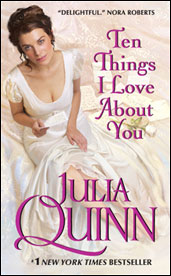
"Ten Things I Love About You" by Julia Quinn
I really enjoyed reading this book because the author made it more about the romance than the sex. A caution for those readers who want their romances steamy hot -- the hero and heroine don't have sex until almost the end of the book.
Annabel and Sebastian are fun and quirky characters and the author did a great job of building the story. Annabel feels pressured (by family financial circumstances) to marry an aging but wealthy earl who wants an heir to keep his nephew from inheriting the title. Sebastian is the nephew and doesn't know his uncle is interested in Annabel the first few times they meet. Without a sex scene every 10 pages or so, she uses the time to develop the characters and make their budding romance feel believable. This book is related to "What Happens in London" because Sebastian is related to Harry from that book and spends a lot of time with Harry and Olivia. The purple prose gothic novel from the earlier book also factors into the plot of this book.
This romance is sweet, fun and romantic but not very steamy. I liked it.
I borrowed this book from my local library.
Annabel and Sebastian are fun and quirky characters and the author did a great job of building the story. Annabel feels pressured (by family financial circumstances) to marry an aging but wealthy earl who wants an heir to keep his nephew from inheriting the title. Sebastian is the nephew and doesn't know his uncle is interested in Annabel the first few times they meet. Without a sex scene every 10 pages or so, she uses the time to develop the characters and make their budding romance feel believable. This book is related to "What Happens in London" because Sebastian is related to Harry from that book and spends a lot of time with Harry and Olivia. The purple prose gothic novel from the earlier book also factors into the plot of this book.
This romance is sweet, fun and romantic but not very steamy. I liked it.
I borrowed this book from my local library.
"The Brazen Bride" by Stephanie Laurens
It's been awhile since I read the first two books in this series (The Untamed Bride (Black Cobra Quartet) and The Elusive Bride (The Black Cobra Quartet)) but I don't recall either of them being quite as steamy as this one was.
Linnet, the heroine, has sex with Logan before she even knows his name (and not just because he has amnesia and doesn't remember it himself) and while he is only semi-conscious. And when Logan regains consciousness and has regrets, she is the one to keep pushing them into ever steamier sexual encounters. It was all a bit much for me.
I'm the first one to applaud a strong heroine in a romance but the character of Linnet felt like overkill to me. Between her various authority roles on the island and her sexual appetite, she was just too too much for me. And with all the pages dedicated to sex scenes, I felt like the sense of developing romance suffered a little.
There was another "relationship" in the book that had an incestuous "ick" factor. Saying anything more about it would spoil part of the plot, but you'll know it when you get to it.
I have enjoyed reading the series (though not nearly as much as the Cynster series or the Bastion Club series), but this was my least favorite so far. Probably my favorite part of this book was the "guest appearances" of a number of Cynster and Bastion Club characters.
I borrowed this book from my local library.
Linnet, the heroine, has sex with Logan before she even knows his name (and not just because he has amnesia and doesn't remember it himself) and while he is only semi-conscious. And when Logan regains consciousness and has regrets, she is the one to keep pushing them into ever steamier sexual encounters. It was all a bit much for me.
I'm the first one to applaud a strong heroine in a romance but the character of Linnet felt like overkill to me. Between her various authority roles on the island and her sexual appetite, she was just too too much for me. And with all the pages dedicated to sex scenes, I felt like the sense of developing romance suffered a little.
There was another "relationship" in the book that had an incestuous "ick" factor. Saying anything more about it would spoil part of the plot, but you'll know it when you get to it.
I have enjoyed reading the series (though not nearly as much as the Cynster series or the Bastion Club series), but this was my least favorite so far. Probably my favorite part of this book was the "guest appearances" of a number of Cynster and Bastion Club characters.
I borrowed this book from my local library.
Friday, July 16, 2010
"Moscow Sting" by Alex Dryden 3 1/2 stars
This is the sequel to "Red to Black," which I had not read. You don't need to have read the first book to understand this one, but reading Moscow Sting likely will spoil the events of Red to Black. (For that matter, reading the plot summary of the second book probably spoils the first one.)
Anna is a former KGB colonel who defected to marry the British spy she was assigned to monitor. Her husband was killed by the KGB before the opening of the book and she is in hiding with her young son. The British, Americans and Russians all want her because they believe she is the only one who knows the identity of "Mikhail," who provided her late husband with Russian intelligence. An American private intelligence company gets to her first and a significant portion of the book involves the process of working her to disclose his identity and contact him to make him an American intelligence asset.
This book was OK for me but it didn't have the suspenseful tension that makes for a truly compelling espionage novel. The author has filled it with a lot of information about the politics of the spy business -- the use of private intelligence companies, the KGB's control of Russian business enterprises, political "horse trading" between the countries. But he tells it to the reader in a way that makes it just so many facts. (I'm assuming he has done the research to make it accurate.) Another thing that made the book less exciting is that it felt fairly believable. The Americans holding Anna didn't torture or drug her to get the information -- they interviewed her. Endlessly. And, with one exception, there aren't gun battles or wild chase scenes.
Believable action scenes that would be too tame for the typical blockbuster spy movie need something more to draw the reader in -- an emotional tie to the character. This book has so many different characters and points of view that it is difficult to get emotionally involved with any of them. Anna is the obvious center of the book but the author puts in too much extra stuff -- a subplot involving an assassin named Lars was an unnecessary distraction from the central story -- and the connection with Anna suffers.
Finally, some of the details make little sense in the context of the story. Anna's handler suggests she take a gun to a meeting where she will be otherwise unprotected. Of all the handgun possibilities, she improbably requests a single shot pistol with a very long barrel to hide under her clothes. And unless this is covered in the earlier book, Anna is much more familiar with New York City than she should be.
Fans of the espionage genre who like a lot of information in the story and don't need page-turning action should enjoy this book. For me, I wanted action or emotional connection to the characters and didn't feel either one.
I received this book from the Amazon Vine program in exchange for writing a review. My opinions are my own.
Anna is a former KGB colonel who defected to marry the British spy she was assigned to monitor. Her husband was killed by the KGB before the opening of the book and she is in hiding with her young son. The British, Americans and Russians all want her because they believe she is the only one who knows the identity of "Mikhail," who provided her late husband with Russian intelligence. An American private intelligence company gets to her first and a significant portion of the book involves the process of working her to disclose his identity and contact him to make him an American intelligence asset.
This book was OK for me but it didn't have the suspenseful tension that makes for a truly compelling espionage novel. The author has filled it with a lot of information about the politics of the spy business -- the use of private intelligence companies, the KGB's control of Russian business enterprises, political "horse trading" between the countries. But he tells it to the reader in a way that makes it just so many facts. (I'm assuming he has done the research to make it accurate.) Another thing that made the book less exciting is that it felt fairly believable. The Americans holding Anna didn't torture or drug her to get the information -- they interviewed her. Endlessly. And, with one exception, there aren't gun battles or wild chase scenes.
Believable action scenes that would be too tame for the typical blockbuster spy movie need something more to draw the reader in -- an emotional tie to the character. This book has so many different characters and points of view that it is difficult to get emotionally involved with any of them. Anna is the obvious center of the book but the author puts in too much extra stuff -- a subplot involving an assassin named Lars was an unnecessary distraction from the central story -- and the connection with Anna suffers.
Finally, some of the details make little sense in the context of the story. Anna's handler suggests she take a gun to a meeting where she will be otherwise unprotected. Of all the handgun possibilities, she improbably requests a single shot pistol with a very long barrel to hide under her clothes. And unless this is covered in the earlier book, Anna is much more familiar with New York City than she should be.
Fans of the espionage genre who like a lot of information in the story and don't need page-turning action should enjoy this book. For me, I wanted action or emotional connection to the characters and didn't feel either one.
I received this book from the Amazon Vine program in exchange for writing a review. My opinions are my own.
Monday, July 5, 2010
"Deception" by Jonathan Kellerman: 4 stars
I have to start by saying I enjoyed the book. I didn't love it but I enjoyed it. Even so, I didn't feel like I was reading an Alex Delaware novel -- at least not the kind Kellerman used to write. As I read this book, I felt that Delaware wasn't acting as a psychologist but more of a ridealong sidekick to Milo. Other than the periodic references to Robin and his French bulldog, I felt it could have any been another detective with Milo and the book would have been the same. Delaware even did internet searches that any rookie cop could have done.
As a basic detective mystery, I enjoyed it. The plot had plenty of twists and turns that kept me from guessing the killer. Just when you think it is one kind of murder mystery, things change and you start to think it is something else and then it changes again. That kept things interesting.
The book didn't have as strong a sense of place as previous novels in the series, but I did learn a new architectual term -- dingbat. When an apartment building was described as being a dingbat, I had to go online to see what kind of building that was -- and it must be a fairly California type because I've never seen anything like that in Minnesota.
I hope Kellerman brings back more psychological aspects to future books in the series, but at least it was an interesting and entertaining read.
I got this book from the library. Support your local library!
As a basic detective mystery, I enjoyed it. The plot had plenty of twists and turns that kept me from guessing the killer. Just when you think it is one kind of murder mystery, things change and you start to think it is something else and then it changes again. That kept things interesting.
The book didn't have as strong a sense of place as previous novels in the series, but I did learn a new architectual term -- dingbat. When an apartment building was described as being a dingbat, I had to go online to see what kind of building that was -- and it must be a fairly California type because I've never seen anything like that in Minnesota.
I hope Kellerman brings back more psychological aspects to future books in the series, but at least it was an interesting and entertaining read.
I got this book from the library. Support your local library!
"Deeper Than The Dead" by Tami Hoag: 3 1/2 stars
The "romance" in this book isn't a full-fledged romance but it is enough to distract a little from suspense part of the book. Without it, the book could have been a stronger period police procedural. "Period" because the book is set in 1985 and the science of crime fighting has come a long way in 25 years. As the author notes in the introduction, DNA is not yet a standard part of the investigation, fingerprint evidence is compared manually, not by computer, and the Behavioral Science Unit at the FBI is not yet popular enough to have its own TV show.
A series of murders in a small California town leads the police to suspect they may have a serial killer in their midst and they call the FBI's Behavioral Science Unit. There isn't enough evidence for the BSU to send a team but injured agent/profiler Vince Leone offers to go help on his own. His injury was distraction enough, the romance he starts with a local teacher pushed the distraction a little too far for me, and a troubled child brought it too close to soap opera to be a really good mystery. With the various other local detectives, I didn't get a strong enough feeling for any of the characters to really care about them.
I thought the killer's identity was telegraphed a little too much (though the author gives the reader a few obvious options); I like to be surprised and learn who it is along with the investigators. Even so, it was a pleasant summer hammock read.
There is a second book coming out later this winter, "Secrets to the Grave." I will probably read that book just to see where the series is going but it won't be at the top of my reading list.
I got this book from the library. Support your local library!
A series of murders in a small California town leads the police to suspect they may have a serial killer in their midst and they call the FBI's Behavioral Science Unit. There isn't enough evidence for the BSU to send a team but injured agent/profiler Vince Leone offers to go help on his own. His injury was distraction enough, the romance he starts with a local teacher pushed the distraction a little too far for me, and a troubled child brought it too close to soap opera to be a really good mystery. With the various other local detectives, I didn't get a strong enough feeling for any of the characters to really care about them.
I thought the killer's identity was telegraphed a little too much (though the author gives the reader a few obvious options); I like to be surprised and learn who it is along with the investigators. Even so, it was a pleasant summer hammock read.
There is a second book coming out later this winter, "Secrets to the Grave." I will probably read that book just to see where the series is going but it won't be at the top of my reading list.
I got this book from the library. Support your local library!
"Dead in the Family" by Charlaine Harris: 3 1/2 stars
I started reading this series long before the TV series and the main reason I liked it was because it wasn't the dark and broody kind of vampire story. There was humor and a lot more lightness. The last couple books have become so dark, I don't think I would have kept reading if the first books had been like this.
"Dead in the Family" picks up shortly after the ending of "Dead and Gone." If you haven't read that one, you probably should wait to read this book because it will spoil the ending of the earlier book. Even though the ending of Dead and Gone was pretty traumatic, there isn't much emotional continuity with this book -- new events come into play and dominate the story.
I don't want to say too much about the plot because I don't want to spoil it but on both the vampire and Were sides, the stuff that happens is dark and unhappy. And on the vampire front, it is pretty far out there with another historic figure as vampire. I think the idea of Bubba is hilarious. This particular vampire is just weird and icky.
I want more lightness and humor back in the stories. The TV series seems darker than the books on which they were based and I hope that is not steering the author away from the humor that was present in the earlier books. Sookie needs a break from the drama and, as a longtime fan of the series, I do too.
I got this book from the library. Support your local library!
"Dead in the Family" picks up shortly after the ending of "Dead and Gone." If you haven't read that one, you probably should wait to read this book because it will spoil the ending of the earlier book. Even though the ending of Dead and Gone was pretty traumatic, there isn't much emotional continuity with this book -- new events come into play and dominate the story.
I don't want to say too much about the plot because I don't want to spoil it but on both the vampire and Were sides, the stuff that happens is dark and unhappy. And on the vampire front, it is pretty far out there with another historic figure as vampire. I think the idea of Bubba is hilarious. This particular vampire is just weird and icky.
I want more lightness and humor back in the stories. The TV series seems darker than the books on which they were based and I hope that is not steering the author away from the humor that was present in the earlier books. Sookie needs a break from the drama and, as a longtime fan of the series, I do too.
I got this book from the library. Support your local library!
Thursday, July 1, 2010
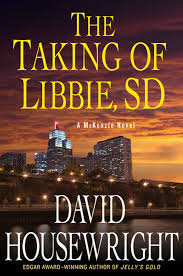
"The Taking of Libbie, SD" by David Housewright
This is the 7th book in the McKenzie series of mystery thrillers and it is one of the most enjoyable, in part because it is such a change of pace for the character. The series starts with "Dead Boyfriends" but if you haven't been reading the series all along, this would be a very good place to jump in.
Rushmore McKenzie is a former cop who left the St. Paul police force so he could collect a multi-million dollar reward for catching an embezzler. He has a deep sense of justice and chivalry and keeps himself busy doing favors for friends. Up to now, all the books have been set in the Twin Cities area -- and many are set in St. Paul. I love Minnesota mysteries by Minnesota authors so I have enjoyed the whole series, even if the last couple books came a little close to being travelogues.
The reason this would be a good book to try and see if you like the series is that the people and places that fill the other books are present mostly by phone -- and even then only occasionally. So the reader doesn't have to know the emotional nature of the relationships. McKenzie is completely out of his comfort zone (and out of the Twin Cities) in this book. The book starts as intruders break into his home, kidnap him and drive him in the trunk of a car to a small town in South Dakota.
A con man has used McKenzie's name and character to swindle the town and they sent bounty hunters to bring him back. They soon realize McKenzie is not the con man and ask him to help them find him and their money. McKenzie is angry at the treatment he received but eventually decides to do this, as much to learn why the con man chose to impersonate him as to help the town.
This is one of my favorite of the series, even though it isn't set in Minnesota, because the focus of the story is on the people -- McKenzie and the people of Libbie, SD -- rather than on geographical landmarks. It was fun following along as McKenzie talks to people to see what he can learn about the imposter in order to find him. There is plenty of action as well -- McKenzie hates bullies and he comes in contact with a couple of them in this small town.
I enjoyed this book a lot and recommend it. If you read this one, you will want to read the rest of the series!
I got this book from the library. Support your local library!
Rushmore McKenzie is a former cop who left the St. Paul police force so he could collect a multi-million dollar reward for catching an embezzler. He has a deep sense of justice and chivalry and keeps himself busy doing favors for friends. Up to now, all the books have been set in the Twin Cities area -- and many are set in St. Paul. I love Minnesota mysteries by Minnesota authors so I have enjoyed the whole series, even if the last couple books came a little close to being travelogues.
The reason this would be a good book to try and see if you like the series is that the people and places that fill the other books are present mostly by phone -- and even then only occasionally. So the reader doesn't have to know the emotional nature of the relationships. McKenzie is completely out of his comfort zone (and out of the Twin Cities) in this book. The book starts as intruders break into his home, kidnap him and drive him in the trunk of a car to a small town in South Dakota.
A con man has used McKenzie's name and character to swindle the town and they sent bounty hunters to bring him back. They soon realize McKenzie is not the con man and ask him to help them find him and their money. McKenzie is angry at the treatment he received but eventually decides to do this, as much to learn why the con man chose to impersonate him as to help the town.
This is one of my favorite of the series, even though it isn't set in Minnesota, because the focus of the story is on the people -- McKenzie and the people of Libbie, SD -- rather than on geographical landmarks. It was fun following along as McKenzie talks to people to see what he can learn about the imposter in order to find him. There is plenty of action as well -- McKenzie hates bullies and he comes in contact with a couple of them in this small town.
I enjoyed this book a lot and recommend it. If you read this one, you will want to read the rest of the series!
I got this book from the library. Support your local library!
Subscribe to:
Posts (Atom)